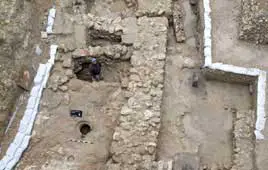
An archaeological excavation the Israel Antiquities Authority conducted revealed new information about ancient Nazareth from the time of Jesus. Remains of a dwelling that date to the Early Roman period
were discovered for the first time in an excavation, which was carried
out prior to the construction of the "International Marian Center of
Nazareth" by the Association Mary of Nazareth, next to the Church of the Annunciation.
 |
According to the New Testament,
Mary, the mother of Jesus, lived in Nazareth together with her husband
Joseph. It was there that she also received the revelation by the
Angel Gabriel that she would conceive a child to be born the Son of
God. The New Testament mentions that Jesus himself grew up in Nazareth.
In 1969 the
Church of the Annunciation was erected in the spot that the Catholic
faith identified with the house of Mary. It was built atop the remains
of three earlier churches, the oldest of which is ascribed to the Byzantine period
(the fourth century CE). In light of the plans to build there, the
Israel Antiquities Authority recently undertook a small scale
archaeological excavation close to the church, which resulted in the
exposure of the structure.
According
to Yardenna Alexandre, excavation director on behalf of the Israel
Antiquities Authority, "The discovery is of the utmost importance since
it reveals for the very first time a house from the Jewish village of Nazareth and thereby sheds light on the way of life at the time of Jesus.
The building that we found is small and modest and it is most likely
typical of the dwellings in Nazareth in that period. From the few
written sources that there are, we know that in the first century CE
Nazareth was a small Jewish village, located inside a valley. Until now
a number of tombs from the time of Jesus were found in Nazareth;
however, no settlement remains have been discovered that are attributed
to this period."
In the excavation a large broad wall that dates to the Mamluk period
(the fifteenth century CE) was exposed that was constructed on top of
and "utilized" the walls of an ancient building. This earlier building
consisted of two rooms and a courtyard in which there was a rock-hewn
cistern into which the rainwater was conveyed. The artifacts recovered
from inside the building were few and mostly included fragments of
pottery vessels from the Early Roman period
(the first and second centuries CE). In addition, several fragments of
chalk vessels were found, which were only used by Jews in this period
because such vessels were not susceptible to becoming ritually unclean.
Another
hewn pit, whose entrance was apparently camouflaged, was excavated and a
few pottery sherds from the Early Roman period were found inside it.
The excavator, Yardenna Alexandre, said, "Based on other excavations
that I conducted in other villages in the region, this pit was probably
hewn as part of the preparations by the Jews to protect themselves
during the Great Revolt against the Romans in 67 CE".
In a few of
the archaeological excavations that were carried out in this crowded
city, a number of burial caves dating to the Early Roman period were
exposed that are situated close to the inhabited area. The modern Church of the Annunciation was constructed in the heart of Nazareth,
above the Crusader Church of the Annunciation and atop the ruins of a
church from the Byzantine period. In the middle of these churches is a
cave that was already ascribed in antiquity to the house of Jesus'
family. Many storage pits and cisterns, some of which date to the Early
Roman period, were found in the compound of the Church of the
Annunciation.
The
"Association Mary of Nazareth" intends on conserving and presenting the
remains of the newly discovered house inside the building planned for
the "International Marian Center of Nazaret
No comments:
Post a Comment